
AI Didn’t Kill Stack Overflow, Quora, or Reddit — It Rewired How We Learn
Stack Overflow, Quora, Reddit — what's changing, what's dying, and what happens to collective knowledge when fewer people contribute back.

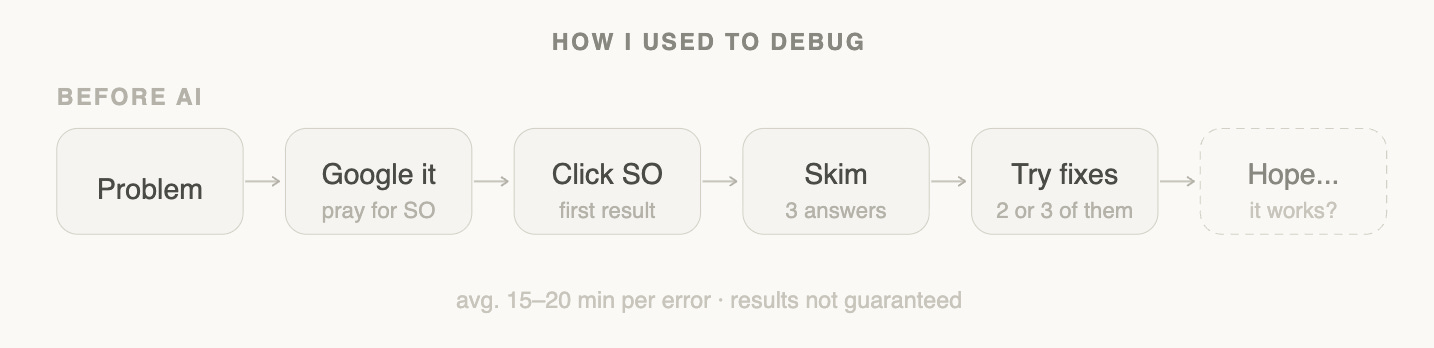
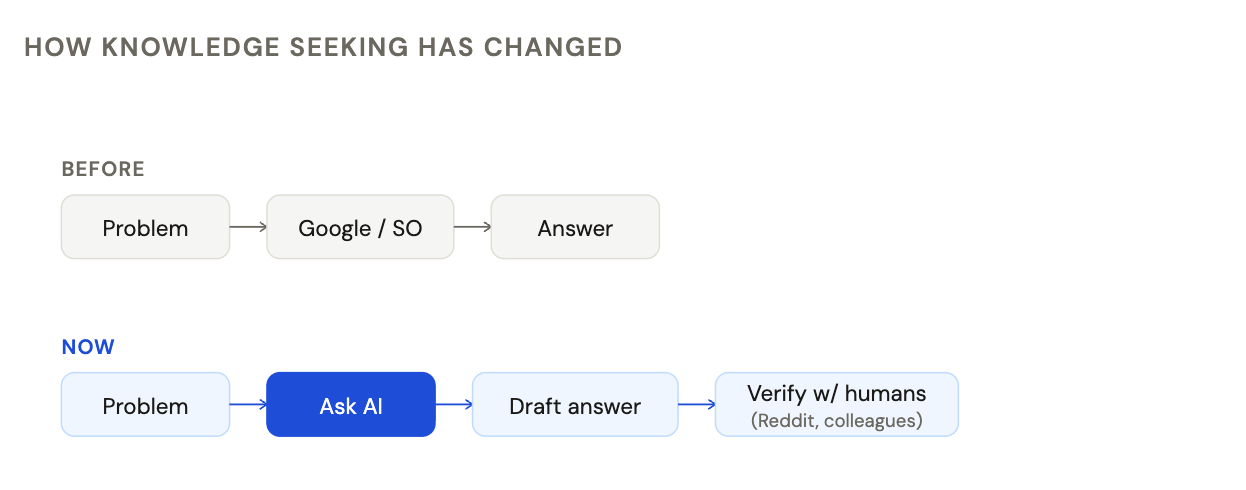
A few years ago, my debugging workflow looked like this:
Open Google → type error → click the first Stack Overflow link → skim answers → try 2–3 fixes → hope something works.
Today? I paste the error into ChatGPT and get a working solution in seconds. No tabs. No scrolling. No “accepted answer from 2016.”
At first glance, it feels like a simple productivity win. But zoom out and something much bigger is happening.
AI isn’t just changing how we find answers. It’s changing whether we ask questions in public at all — and that distinction matters enormously.
The Shift in One Line
Google gave you links. AI gives you answers.
That one sentence sounds obvious until you sit with what it actually means for the infrastructure of knowledge on the internet.

Or put differently:
AI didn’t replace Stack Overflow.
It replaced the need to ask publicly.
The Old Model: Knowledge as a Public Good
For nearly two decades, the internet ran on a beautifully simple loop:
Someone had a problem
They asked it publicly
Someone else answered
The answer stayed searchable forever
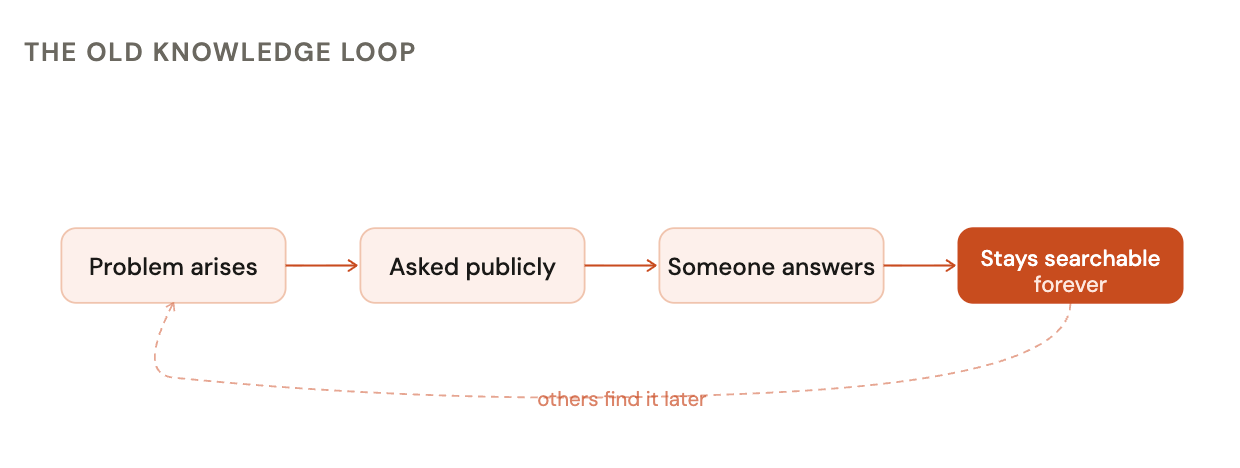
This created an incredible public archive of knowledge.
Stack Overflow became the default brain for developers
Quora became a place for long-form thinking
Reddit became a mix of expertise, opinions, and lived experiences
The key idea was simple:
If you had a question, someone else probably already asked it.
The New Model: Knowledge as an Instant Service
AI breaks this loop.
Now the flow looks like:
You have a problem
You ask AI privately
You get a tailored answer instantly
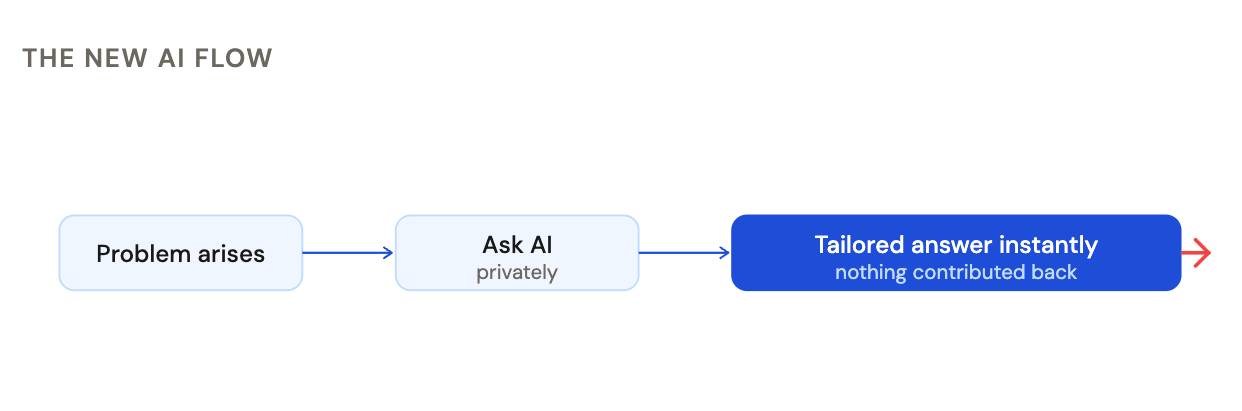
No waiting.
No posting.
No contributing back.
That small change has enormous second-order effects — not just for these platforms, but for the quality of knowledge the internet will hold five years from now.
The Contrarian Take
AI didn’t just disrupt these platforms.
It exposed that a large percentage of questions were low-value to begin with.
- Repetitive
- Already answered
- Easily automatable
That’s exactly why AI could replace them so quickly.
This isn’t just a technology shift.
It’s a filtering mechanism.
AI is removing the need for questions that never needed to be asked publicly in the first place.
1. Stack Overflow: From First Stop to Backup Option
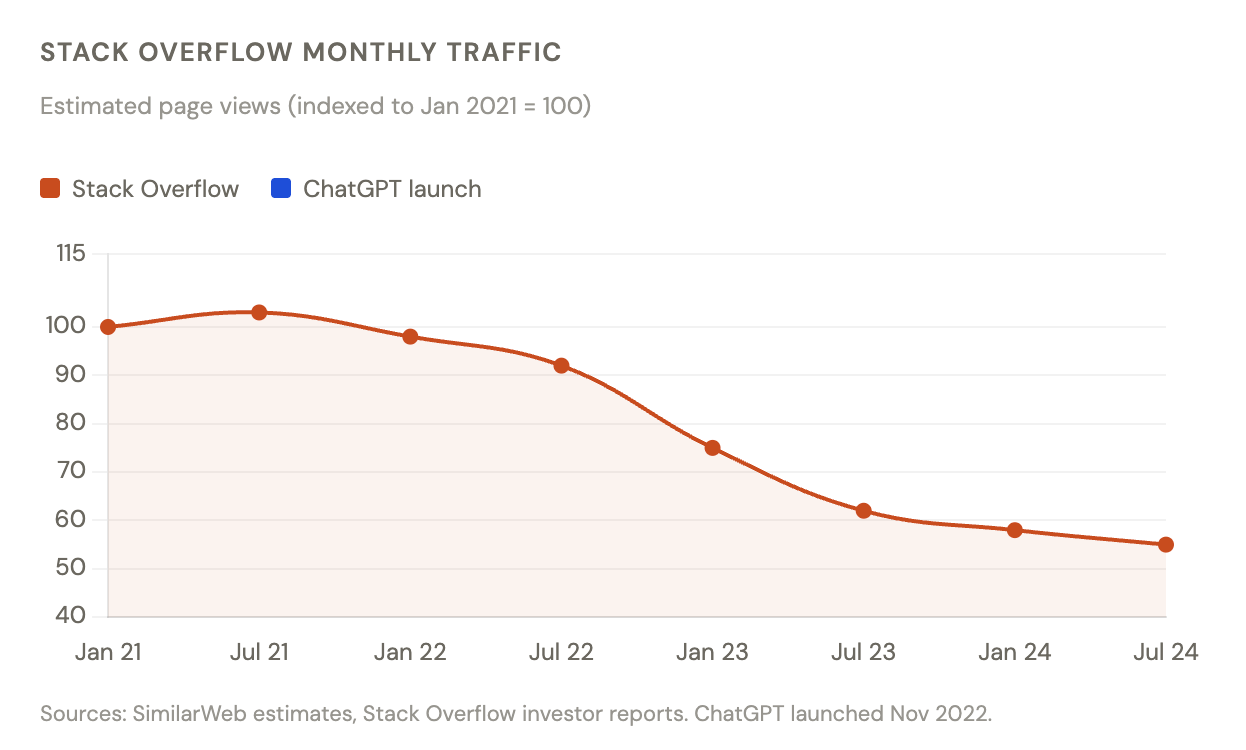
Stack Overflow is where the shift is most obvious.
Its core value was speed + accuracy for coding problems.
But AI is simply better at that use case.
A real example
I recently hit a Python issue:
“RuntimeError: This event loop is already running”
Earlier, I would:
Search Google
Open 3 Stack Overflow threads
Try different answers
Piece together a solution
~15–20 minutes
Now:
Paste error into ChatGPT
Get the exact fix + explanation
Done in under 30 seconds
I didn’t even think about opening Stack Overflow.
But there’s a catch.
AI feels right even when it’s wrong.
In many cases, it produces answers that are:
- Confident
- Clean
- Slightly incorrect
And because the experience is so smooth, it’s easy to trust it without verifying.
That’s a very different failure mode compared to Stack Overflow, where disagreement and discussion were visible.
What changed?
Stack Overflow answers are:
Static
Context-limited
Often outdated
AI answers are:
Context-aware
Interactive
Personalized to your code
That’s a fundamentally better experience.
There’s another uncomfortable truth here.
Even before AI, the system wasn’t perfect.
Research shows:
~58% of answers on Stack Overflow were already obsolete when posted
Only ~20% ever get updated
Meaning:
Even before AI, the system had cracks.
AI didn’t break it.
It just made those cracks visible.
It just exposed the fact that static, community-driven answers struggle to keep up with fast-moving ecosystems.
The result
Stack Overflow isn't dead. But it has quietly shifted from being the first stop to a fallback — a place for deep threads, edge cases, and historical context that AI can't yet replicate. For most day-to-day debugging? Developers aren't even opening the tab.
It’s becoming:
A fallback for edge cases and deep threads.
2. Quora: When AI Becomes the Content
Quora took a very different path. Instead of resisting AI, it embraced it — launching Poe and leaning into AI-generated answers. At first, this seems smart. More answers, more content, more engagement.
But something subtle broke.The “uncanny answer” problem
Try searching:
“How do I become a better software engineer?”
You’ll find answers that are:
Well-structured
Grammatically perfect
Logically correct
But…
They feel empty.
No real stories.
No scars.
No “this failed in production at 2 AM.”
Why this matters
The value of Quora was never just information.
It was:
Perspective from people who had actually done the thing.
AI can simulate knowledge.
It struggles to simulate lived experience.
And when too much content is AI-generated, the platform starts to feel like:
A content factory instead of a thinking space.
3. Reddit: Still Standing (For Now)
Reddit is holding up much better.
Because its core value isn’t answers.
It’s people.
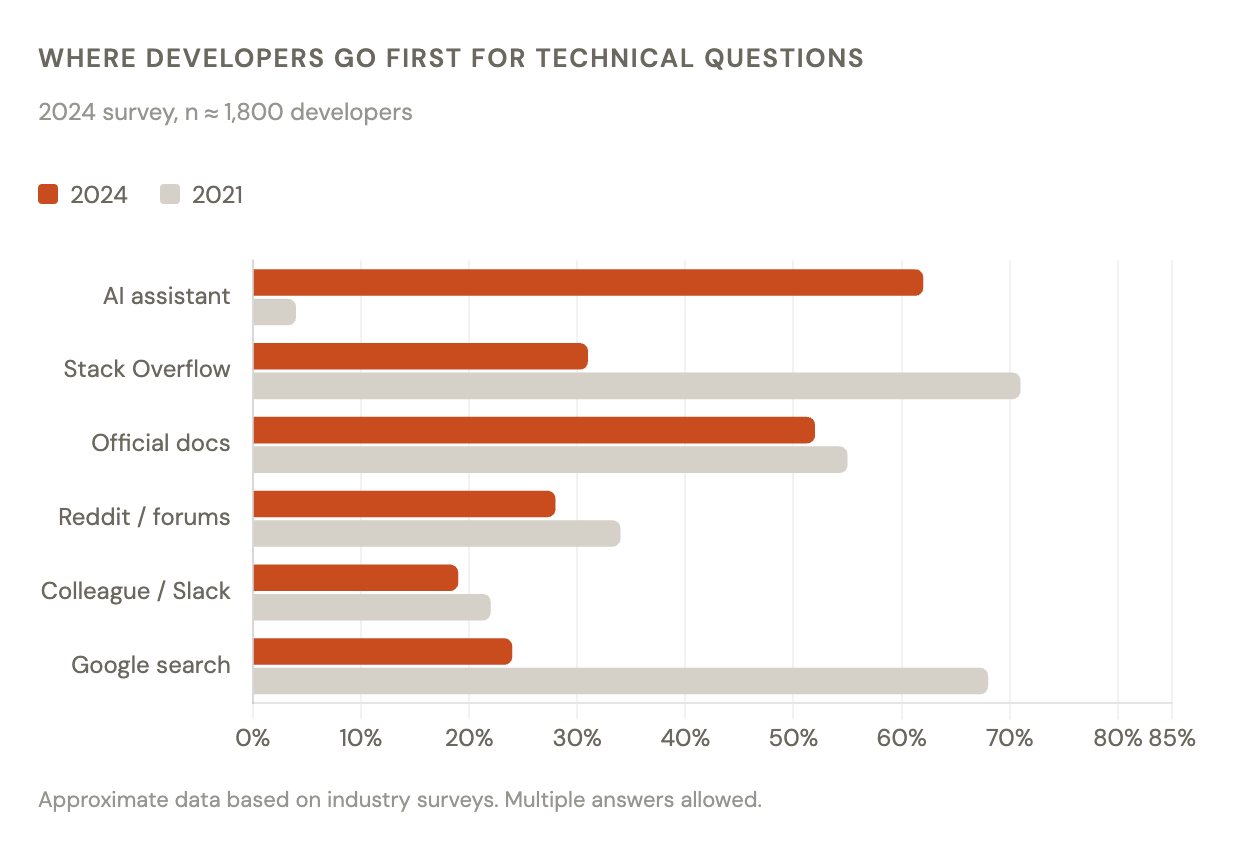
I still go to Reddit, but not for things like:
“What is Kafka?”
“Explain microservices”
I go for:
“Did this architecture actually work in production?”
“What are the real downsides of this approach?”
“How bad is on-call in this company?”
A real example
I was recently deciding between:
Event-driven architecture
Synchronous APIs
AI gave me:
Clean pros/cons
Structured explanations
But Reddit gave me:
“This blew up at scale because…”
“Debugging this is a nightmare”
“We had to roll this back”
That’s not information.
That’s experience.
Why Reddit survives
Because people don’t just want answers.
They want:
Validation
Contradictions
War stories
Nuance
And that’s still very hard for AI to replicate.
The Bigger Shift: From Discovery to Validation
The most important change is behavioral.
We’ve moved from:
“Ask the internet”
to:
“Ask AI, then verify with humans”
That’s a big deal.
Because it changes the role of communities:
Before: primary source of answers
Now: secondary layer for validation
The Hidden Risk Nobody Talks About
There’s a second-order effect here.
AI models are trained on:
Stack Overflow
Reddit
Quora
But now:
Fewer people ask questions publicly
Fewer people write detailed answers
More content is AI-generated to fill the gap
So over time:
The quality of the source knowledge itself may decline.
It’s a strange loop:
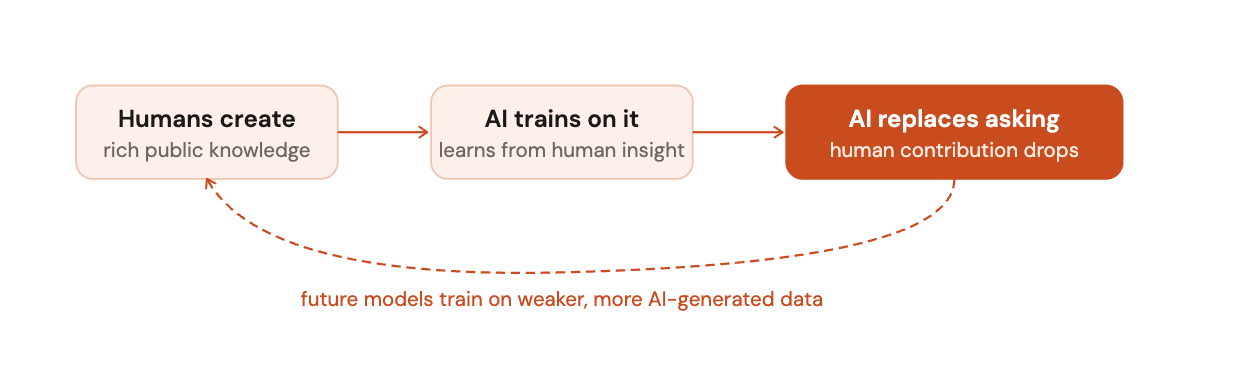
We’re still early, but this feedback loop is worth paying attention to.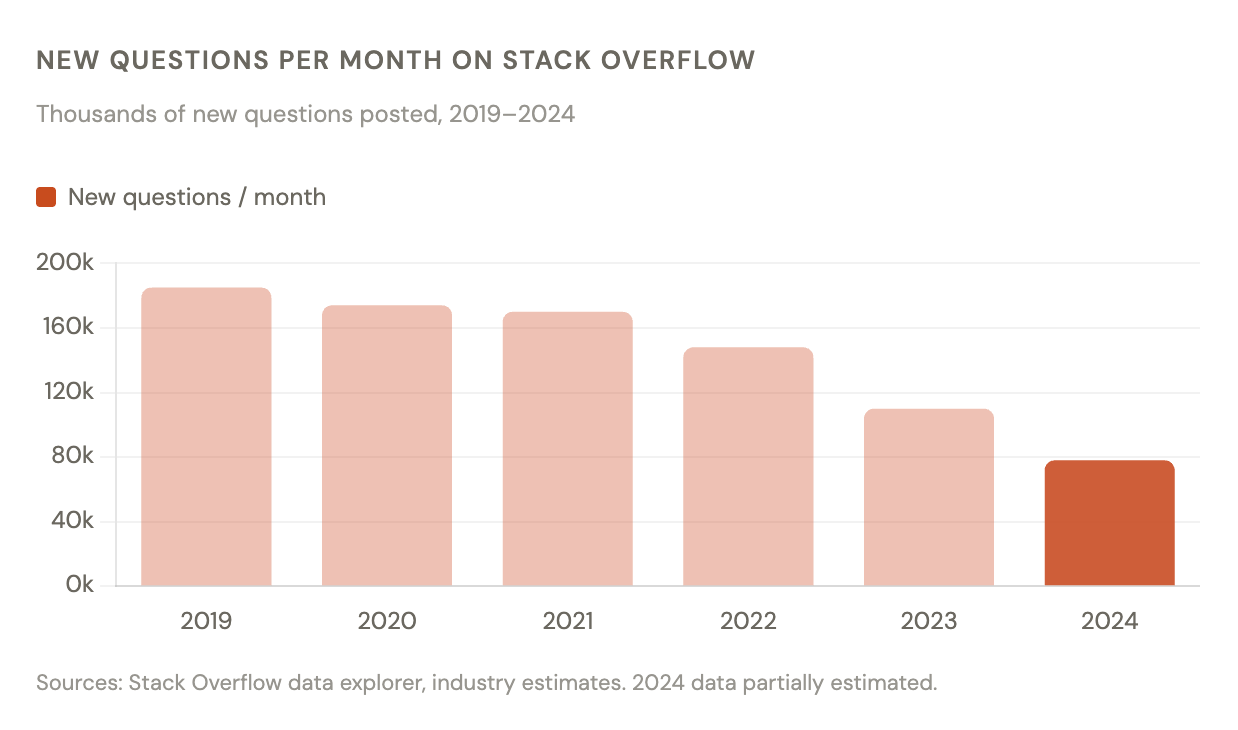
What This Means for Engineers
If you’re a developer, this shift matters a lot.
Because it changes what skills are valuable.
What’s becoming commoditized
Syntax knowledge
API usage
Basic debugging
“How do I fix this error?”
AI handles these extremely well.
What’s becoming more valuable
System design decisions
Trade-offs
Debugging complex distributed systems
Understanding real-world constraints
Experience-backed judgment
In short:
Knowing what to do is less valuable than knowing why and when to do it.
In other words:
The value is shifting from answers → to judgment.
My Personal Workflow Now
This is how I work today:
Start with AI
Fast answers
Quick iterations
Unblocks me instantly
Move to community when needed
Edge cases
Conflicting opinions
Real-world validation
Trust experience over perfection
If an answer feels “too clean,” I double-check
Final Thought
AI didn’t kill these platforms.
It just removed friction.
And once friction disappears, behavior changes.
We ask fewer public questions
We rely less on shared knowledge
We move faster, but contribute less
The internet is shifting from:
A shared brain
to:
A private assistant
We’re moving from:
A shared brain → to → A private assistant
And that raises a deeper question:What happens to collective knowledge
when fewer people feel the need to contribute back at all?